




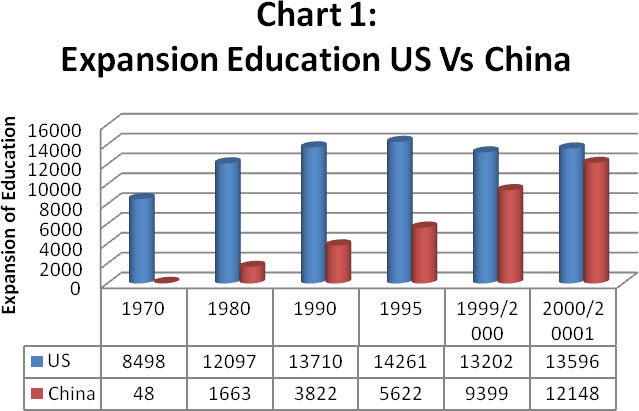
In recent times, we observe and measure people and organization progress on a global scale. Globally, millions of dollars are spent on education, and very often we believe that those countries that spend the most to educate their people would have the highest success rate among graduates and would make up the richest countries. However, these numbers can be misleading because I also learned that the importance of understanding education is to explore and discover the latent skills
References
The New York Times Company.
(2013, January16). Next Made-in-China Boom: College Graduates. The New York Times. Retrieved from
http://www.nytimes.com/2013/01/17/business/chinas-ambitious-goal-for-boom-in-college-graduates.html?partner=rssemc=rss&_r=0
The New York Times Company.
(2013, January 21). The
Effects of China’s Push for Education.The New York Times. Retrieved from
http://www.nytimes.com/roomfordebate/2013/01/21/the-effects-of-chinas-push-foreducation
______________________________________________________________________ Module 1 Unit 3: Economics of Education I: Human Capital
Theory
______________________________________________________________________________
On a case-by-case-scenario in the working world, people have been the best resources for organizations. Some organizations valued their employees and treat them fairly, while some employees were treated unfairly by their employers. In this view, from my readings, I learned that human beings can be viewed as human capital, and I do agree to some extent that human beings should be called capital. In addition, human beings are been referred to as capital or human capital because of the direct correlation among their resources of knowledge, skills, talents, experience and other factors that have contributed toward the growth and development of the economy (Schultz, 1961, p 3). In some instances slave owners bought and sold slaves because it was cost-effective for slaves to work on large plantations as economic capital. In this view, the human capital theory argued that human beings can be considered as capital.
From my reading, I learned that some people viewed human capital by attaching value to people in a mode similar to slavery. I have also learned that there are many ways to attach value to people that reflect the worth of their skills and knowledge. The Human Capital Theory is a broad theory which emphasizes the knowledge and skills those workers usually contribute are the set of characteristics and skills that contribute to an increase in productivity. Therefore human capital is not always a result of formal education and skills that attributed to innate ability, informal education, non-school experience or training.
In addition, I do agree that laborers have become capitalists in the sense of the entrepreneurship in the business sector. In this scenario, an entrepreneur aim is to maximize profit, and if the business is not profitable then it will not be cost-effective for the business to continue its operation. Therefore the entrepreneur will have to dismiss some of the staff to reduce the economic cost for production, in order to meet the profit margin for the business, and avoid a nosedive for the business.
Conversely, I do believe that some people do not see the missing link between education and earnings in the skills of forming effect of formal education. People have continued to develop their skills and talent in a remarkable way without achieving higher education. In this regard, most farmers who have little or no education are owners of large plantations with the cultivation of permanent and cash crops, and the rearing of cattle on their plantains. The farmers harvest their produce and earn a large amount of income, because they supply the domestic and the international markets with their produce. This is indeed a typical example that confirmed some people do not have a formal or higher education to determine their success in life to contribute to the growth and development of domestic and international economies.
Reference
Schultz, T. W. (1961). Investment in Human Capital. American Economic Review, 51, 1-17.
____________________________________________________________________________________
Module 1 Unit 4: Screening Theory
___________________________________________________________________________________
After reviewing Module 01, the Screening Theory (ST) seems to be more convincing to me than the Human Capital Theory (HCT). Nevertheless, both theories have in common are the aspect of increased productivity. Some employers are often of the opinion that the employee or applicant without a very sound education background (over qualified) would be the best candidate for the job, if that person has the working knowledge and talent in the field for that job. In additional, I am aware of an employee who has attained an executive position without a first degree education background. In this view, some employers prefer the employee or applicant with the knowledge and skills to proficiently complete the job in an efficient manner. However both theories play a vital part with regards to the manner in which you utilize the knowledge and skills you acquired at school, and the talent and proficient knowledge you have to complete the tasks on the job. Hence, it is indeed difficult to separate the concepts of the ST and HCT.
______________________________________________________________________________
Module 1 Unit 5: Measuring Returns: Internal Rate of Return (IRR)
and
Module 1 Unit 6: Rates of Return to Education (RORE) to Education
_________________________________________________________________________________
Over the years, I have been an entrepreneur, who worked in several organizations, attending university/college classes and or taken classes. I will continue to work and study because I believe that education is one of the greatest investments in life. Ouch! I will not worry about the amount of money being spent on my education, because my ache and pain are diminishing when I think of the tuition and student loans as an investment. Nevertheless, when I reflect on what I learned from the Human Capital Theory, I have recognized that educating our employees can be considered an investment. I have also learned about how to measure the value of the employees. In some instances, the employees’ knowledge and skills may be compared to machines, because most employers value their employees unfairly. I know that machines may be more efficient and cost effective in terms of productivity. Nevertheless, machines cannot provide human contact for customers, be thoughtful, patient, or courteous with customers.
In addition, I do believe that obtaining higher education will promote investment because the pictorial illustration revealed that a person who has a bachelor’s degree will earn an increasing amount of income over their lifetime than a person with a high school diploma. In rare cases, there are always exceptions. Conversely, there are some cases where people who may earn more than people with degrees because those people may have acquired specialized training instead of a four-year degree that provides them with qualifications against a person with a degree and no training.
However, as a global competitive educator and director of Julia’s Global Enterprise Inc., I have decided that I wanted to create an opportunity to explore for my knowledge and skills in order to earn the highest promising salary for myself. This is my second master's degree, and I do believe that my additional academic qualification and experience will create more windows of opportunities for me to have better paying position and retirement benefits. Education is indeed one of the best investments in life that surpassed the long-term benefits.
Module 1 Unit 7: What the figures say
___________________________________________________________________________________
I am sharing some pertinent data over a 3 year period on RORE with regards to the fund that was invested toward achieving the following objectives to varying degrees: growth, income and preservation of capital, depending on the proximity to its target date. See the table below:
• High & Low Prices

Reference
American Funds College. (2015). Individual Investor Retrieved from
https://www.americanfunds.com/individual/investments/fund/cffax#
Module 1 Unit 8: The dynamics of educational expansion
After reviewing Module 01, I learned that when people argue that education is a positional good they mean that when people are educated they can achieve economic growth, which can also improve the overall quality of lifestyle for people. Education has been one of the best investments in my life for me. Hence, I will continue to explore for higher education in order to acquire personal development and upward economic mobility with social status. I will also emphasize that the expansion of education as a positional good, created better opportunities for me to develop higher status in every facet of my life. Additionally, education is compatible with Human Capital Theory because education has recently been re-theorized under Human Capital Theory as an economic (fiscal) mechanism.
Reference
Schultz, T. W. (1961). Investment in Human Capital. American Economic Review, 51, 1-17.
____________________________________________________________________________________
Module 1 Unit 9: The role of distance education
After reading Module 1, I do agree with authors like John Daniel that distance education is necessary to cope with unabated demand for expanding education. Globally, there is a massive expansion of technology developments which create opportunities for learners to access information with online learning applications and asynchronous learning programs. In this regard, distance education (DE) will be one of the fundamental factors for expanding education especially for developing countries which encounter socio-economic hindrances with limited pedagogical and learning resources.The features of the Cloud Computing Platform (CCP), Information Communication Technology (ICT), and particularly the Learning Management Systems (LMS) will enable DE to cope with the large numbers. Huelsmann and Daniel seem to have different views on traditional and distance education. However, Huelsman does not agree that economic development occurs because of the increasing supply in graduates. Conversely, Daniel agrees that there is a great demand of other factors that need to be address in order to determine the occurrences of economic development.
References
Hülsmann, T. (2011). Distance education: From access to accumulation, The Fourteenth
Cambridge International Conference on Open: Distance and e-Learning
Internationalisation and Social Justice: the role of Open, Distance and E-learning.
Cambridge, UK.
Rumble, G. (2007). Social justice, economics and distance education. Open Learning: The
Journal of Open and Distance Learning, 22(2), 167 -176.
Module 2: The Techniques of Cost Analysis
Modeling
Costs, Generic Template, Cost Analysis, Capital Costs,
Operating Costs, and Depreciation
After reviewing Module 2, I learned that this section required the most involvement in math and statistics, which I have improved my knowledge and skills to complete the entire worksheet and cost analysis project. I have learned in developing a distance education program, it is necessary to create a budget and with the ingredients and costs, particularly for this assignment. The ingredients approach was very helpful because it broke down the process for any basic learner. I also learned that the ingredients approach is similar to the process of preparing a meal. Therefore the theory of the ingredients approach assisted me in understanding the cooking process and know-how process to prepare this meal (OM DE 606 course). In addition, you have to decide what: course to teach; activities needed for the course; costs, supplies, and specific quantities of items needed for the course; and furniture, equipment, and human resources needed for the course. In this regard, costing was not challenging for me to calculate. I also learned that it was important to understand each of the categories of the ingredients approach, in order to be able to complete the information that was needed for the budget for a true representation of the actual and anticipated budget expenses. Human resources involve employees and staff, and could include regular or temporary staff that may change on a yearly basis.
My OMDE 606 cost analysis/ modeling cost project was very interesting and informational. I learned how costs are broken down for budget purposes, and may not be determined initially. Costs are categorized as fixed/variable or capital /operating costs. These categorized costs are used to determine what information will be used to create a budget. A way to determine projected costs, is by performing a cost analysis for direct and indirect costs. Cost analyses look at how a budget is created, capital costs and the basic equations for costing. This includes development of course materials, course presentation (teaching and student support), and other indirect cost overheads that are not directly related to the course. In addition, the costs have to be categorized as either capital costs or operating costs. The capital and operating costs are handled based on the various areas of operating costs, which includes depreciation of capital costs, simple depreciation, capital costs and social discounts and annualization. Operating costs are those costs that will be used within the financial year that the costs which occur are generally recurrent. Capital costs are often non-recurrent costs, some of the capital cost items lose their value over a period of time, and these items must be depreciated each year. I understand the importance of these processes, but I still need to do more practices on them.
Reference
Levin, H. M. (1983). Cost-effectiveness: A primer. London: Sage.
Module:3
The
Cost Effectiveness of Distance Education Institutions
Social
Justice and Distance Education
After reviewing Module 3, I learned that distance education (DE) is characterized through sharing of knowledge as a result of the expectations of universities, learners, and other stakeholders, which depends on the social structures of their intellectual system. These social structures promote opportunities for social productivity. There is a demand for higher education in DE, which has caused a commercial rise for the DE commodity. In this regard, the higher DE learning institutions should sustain the development of the character of DE (Rumble, 2007). In addition, the distance education (DE) institutions should offer more cost effective programs for students, compared to traditional education intuitions. These DE institutions should also offer more opportunities for a wider range of people through economies of scale
I have also learned that the DE universities in the developed and developing countries are well-established in the development of Information Communication Technologies (ICTs) and the political principles of social change. They are also concerned about the cost effectiveness in which DE is delivered through the separation of time and space to enhance pedagogical skills and inspire student learning. Nevertheless, DE is not only cost effective for learners, it is a valuable commodity, which is accessible to learners and it is not restricted by location. Distance education is also available with flexibility for working adults, who have to be engaged in other responsibilities that are concurrent with their DE program.
Reference
Rumble, G. (2007).
Social justice, economics and distance education. Open Learning, 22(2), 167-176.
Module 4: Costing educational technologies I: mass media
Classifying media
After reviewing Module 4, I have learned that the media offers a variety of information for instructional designers to incorporate into a media-rich program toward promoting the importance of distance education (DE). Hence, it is very important to have cost effective and cost efficient structured media program for DE teaching and learning environments.
Globally, there is a massive increase of technological advancements that promote 21st century learning and innovation skills. Traditional correspondences (print-based DE) courses are becoming obsolete. Web-based instruction courses have superseded the correspondence courses. The Web-based instructional courses generate the increase of cost efficiency and create economies of scale because of the numerous amounts of a give population that are participating in the courses. For example, as current graduate student of University of Maryland University College (UMUC), I am acknowledging that the Web-based instruction courses are booming at UMUC. This university offers an intensive interactive learning experience through the LEO learning management system, where the teaching and learning occurrences are conducted in a virtual intellectual environment. In this regard, innovative media- rich courses have more or less replaced the postal mail processes of early DE practices.
Module 5: The Cost and Costing of E-Learning
Business models of cooperation
After reviewing Module 5, I learned that a distance learning (DE) university may decide to partner with traditional colleges as learning centers for their students, in order to share their costs for their large number of students. This arrangement may be considered as a cost effective and cost efficient strategy for DE learning institutions, rather allocating new locations or spaces to accommodate their students. For example, the University of Maryland University College (UMUC) uses the University of Maryland, College Park location as a learning center for their students. In this regard, it is a cost effective strategy for UMUC to collaborate with the University of Maryland at College Park location, rather to incurring a high cost in building new student centers for their students to attend their course sessions.
_____________________________________________________________________
Module 6: Cost and Economics
of Student Support
Dropout
Rates and Cost Effectiveness
After reviewing Module 6, I learned that there are several factors that can be considered to measure dropout rates in order to measure the success of each student. These factors include cost effectiveness, student support, family support, self-efficiency, study time, learning outcomes, environmental issues, time management, among other significant factors. Hence, dropout rates can be considered as a variable factor to measure the success of each student.
The distance education (DE) courses are
designed differently among the universities. In this regard, it is complicated
to measure the dropout rates because the institutions offer Web-based
instructional courses, which are designed in various forms, with a variety of
platforms that provide different levels of student support services. For
example, if a particular student decides to dropout from a DE course, that
dropout rate can be influenced by several factors which include cost
effectiveness, student support, family support, self-efficiency, study time,
learning outcomes, environmental issues, time management, among other
significant factors. Conversely, the course designer can be another factor that
contributes to each student outcome or dropout rate. For that reason, the number
of students that dropout and graduate should also be taken into consideration.
It is therefore important to emphasize that several student factors and
learning conditions should be taken into consideration to determine the success
of students with regards to students’ graduation and retention rates in virtual
learning environments (Rumble, 1997).
Reference
Rumble, G. (1997). The costs and economics of open and distance learning. London:
KoganPage
Julia’s UMUC OMDE 606 Learning Outcomes
As a graduate student of UMUC, it was very important for me to sustain the course goals.
The OMDE 606 course enables me to be a more competent partner in the process of setting up and managing economic aspects of distance education, both on institutional level as well as on course level, with regards to media choice. At the end of this course I have achieved the following objectives, whereby I am able to:
- review the expansion of education and the soaring costs of educational provision.
- understand the conceptual framework of 'Human Capital Theory', the core theory of economics of education.
- identify the cost drivers in distance education systems and is able to measure them.
- understand the role of overheads and the problem of cost attribution.
- treat capital costs including the annualization of costs.
- handle the basic cost model and is able to analyze scale economies.
- analyze and compares the cost structure of media and handles a cost model for rapid cost appraisal of a selected media configuration.
- apply the costing methodology to net based learning and identifies the cost-drivers specific to net based learning.
- discuss the impact of net based learning on the cost-structure of distance education..
- analyze the costs of online student support.
Translate This Page

